The Five String Banjo
Last updated 10 November 2012
You hum it son, I'll play it!
Introduction
This page covers some general topics on the 5 string banjo. There are 2 more pages that go into more detail on specific topics:
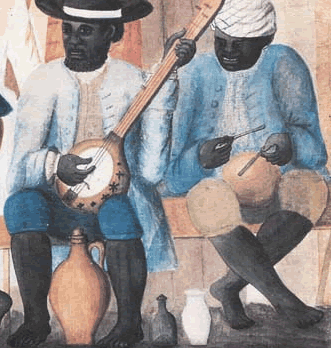
|
The banjo, together with the accordion, is probably the musical instrument most subject to ridicule - partly due to the weird and wonderful personalities often found playing the instrument and partly due to that historically, the banjo was accessible to the lower classes so that much of its repertoire could be relegated to the class of 'simple folk music'. Most people associate the 5-string banjo with Country and Bluegrass - but musicians are gradually (though slooowly) venturing beyond these realms. Bela Fleck, being the most famous example of this, plays classical, funk, jazz, and contemporary music with equal dexterity. The sound of the banjo is something special, the conduction of sound vibration through the bridge and the skin (which is tightened around a metal or wooden Tone Ring) creates a unique tone which is very different from the tone created by wooden string instruments. Old Time banjo is played with the back of the fingernail(s), creating a mellow plucky tone, while Bluegrass is played with metal picks, giving it a more driven, mercyless, ring-like tone. |
|
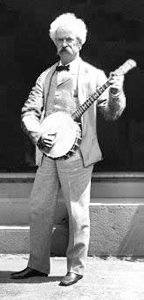
It was this tone that attracted me to the banjo, more than its repertoire. Naturally it affects people differently - in 1865, Mark Twain in his typical quirky style wrote: The piano may do for love-sick girls who lace themselves to skeletons, and lunch on chalk, pickles, and slate pencils. But give me the banjo. . . . When you want genuine music - music that will come right home to you like a bad quarter, suffuse your system like strychnine whisky, go right through you like Brandreth's pills, ramify your whole constitution like the measles, and break out on your hide like the pin-feather pimples on a picked goose - when you want all this, just smash your piano, and invoke the glory-beaming banjo.
|
|
|
The people having the greatest influence on my banjo playing were/are
|
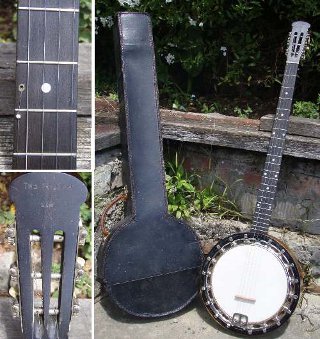
I currently prefer playing the banjo tuned a fourth lower (with heavier gauge strings). It gives me a fuller sound, having the punch of the tenor banjo combined with the harshness of the 5 string. Each time I revert to an originally tuned banjo, it sounds rather thin.
The Banjo's African heritage
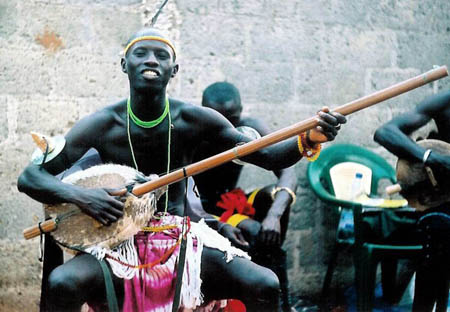
The banjo as an instrument went through quite an evolution since its proclaimed introduction in America by the African slaves. Africa boasts many instruments made from gourd (dried shell of a fruit) and animal skin - one of the most famous one being the kora which stems from Mali in West Africa and has 21 strings. Other instruments that are more banjo-like are the Kontingo, the Xhalam, and the Ngoni from Mali, and the Buchundu which is played by the Manjog people in Gambia. But the one instrument that has most in common with the modern banjo is most likely the Akonting, which is played by the Jola people in Gambia. Though it only has three strings, it sports a major feature of the 5 string banjo: the short string on top of the neck - the so-called 5th string. And what makes it even more likely to be the father of today's banjos is the playing style - very much like the old-time clawhammer technique, also called frailing.
The frailing technique involves playing individual notes with the back of the index or middle finger or brushing with the back of the hand on the downstroke and plucking a string (often the fifth string) with the thumb on the upstroke. It's an unusual technique to learn.
Some years ago, a Sudanese friend of mine played me a recording of some Sudanese music. It really caught my attention because it sounded so much like banjo, not only the sound but also the manner it was played in. You can hear an excerpt of this recording here.
A reference to the origin of the word banjo can be found in Thomas Jefferson's notes on African American music in Notes on the State of Virginia (1781):
The instrument proper to them is the banjar,
which they brought hither from Africa ....
Bela Fleck who went to Africa in 2009 to research this topic and recorded with various African musicians including the great acoustic guitarist D'Gary, singer Oumou Sangare, kora player Toumani Diabate, and Bassekou Kouyate has this to say:
The akonting could very well be the original banjo. Everyone
around Banjul certainly seems to
think so! Huge numbers of
slaves came west from this area. We were told that the musicians
were
allowed to play these instruments on the slave ships,
and that many lives were saved due to it.
Some great articles on the subject of banjo ancestors and the Akonting can be found on the shlomo music website
Tuning and Strings
Following are the 5 standard tunings for the banjo. Each has a characteristic sound, mainly due to the 5th string which is tuned to a different interval in each case. The tuned strings are listed from fifth string (the short one) downwards.
- Open G - [g D G B D]
Standard Bluegrass and Old Time tuning - key of G - fifth string is root (g).
Sometimes the 5th string capo is set to different pitches (such as a or b) to facilitate playing in different keys. - C tuning - [g C G B D]
Bluegrass and Old Time tuning - Key of C - Fifth string is Fifth (g) - Open D - [a D F# A D]
Bluegrass tuning - Key of D - Fifth string is Third (F#) or Fifth (a) - Double C - [g C G C D]
Old Time tuning - Key of C - Fifth string is Fifth (g) - D dorian - [g D G C D]
Old time tuning - modal - pentatonic
The standard string gauges I use are, from the 5th string down: .010
.023 .016 .012 .010
As stated previously, my favourite setup
now is Open G tuned a Fourth down. For this you need heavier gauge
strings. From the fifth string down, John Hartford uses .012 .024
.020 .014 .012 with a wound third (the 20 gauge) string. Ideally you
use a '24 fret banjo' such as the John Hartford Deering Banjo.
I would too, if I had about 5000 dollars spare :(
You would think that using heavier gauge strings puts more strain on the neck - but that is not a given, it's all relative... See my writing on String Tension for more on this.
Picking Technique
In learning a new tune I often encounter unique characteristics that I know will help my technique overall. I hope to convey these techniques in the following chapters, as well as various approaches to difficult passages.
Not wanting to preach too much, I would like to list some practice hints here related specifically to the banjo.
- In determining what the best way of playing a passage is, note that notes fingered on strings whose open notes are a part of the scale are less efficient: D: d e f# g 9-7 on string 3 and 2 are better than 5-4 on strings 2 and 1 [Mississippi Dew example]
- Learn solos from other instruments - eg violin: mississippi dew, mandolin: leather britches
- Notice that sometimes it seems ther RH is having difficulty while it's actually the LH or the synchronization of both hands that's the problem
- Learn left hand with easy rh version using p's and h's, then adapt right hand for best sound
- LH-RH synchronization is the key to mastering the banjo and string instruments in general. The HOs and POs should be in time (I for one tend to play these to quick).
And some more general practice hints:
- Speed comes from accuracy
- Practice the difficult passages mainly
- When practicing with backup, always try to catch up with the tune after a mistake
- Don't let mistakes creep in
- Place notes for musicality, not for convenience
- Difficulty of passages vary at different speeds. Aim to practice close to the required tempo (Suzuki method).
- Only press on the frets as hard as needed
- Learn the correct fingering at the start (it has to work at the proper speed). Mistakes are hard to undo.
Notation, Tablature and Software
People get all worked up on the topic of music notation - claiming it affects the music. But I suspect that's just because they're not very good at it. Notation is just a means to an end, a tool. The trick is not to become dependent on it. My advice would be to use notation to learn or notate stuff, but relegate it to memory as soon as possible. That way you get the best of both worlds. Just as books enable the masses to read, so does music notation and tablature make music available to everybody that's willing to learn it, and that can't be a bad thing.
The music I will publish on another page will be in the TEF format. These files can be opened with freely available software, called TEFView. With this you can display the notation (both music and tablature) and play the files as MIDI, meaning you can transpose, alter tempo, and all that good stuff. If you want to be able to edit, create or alter the files yourself you can get TablEdit from the same page at a low cost (around USD 60). The TEF file format is widely used and appears on many websites that feature tablatures.
While the result is generally good, the software takes some getting used to. For reference purposes I'm adding some notes here on TablEdit, because one tends to forget ...
- F4 → F9 whole note to 32nd note
- . = rest
- TAB = Advance cursor
- Form (da capo etc): Midi → Reading list (right column displays song list)
- LH fingering: Notes → Picks strokes + Fingerings (use bottom T,I,M system)
- J: revert back
- M: Mute
- Pull-offs, Hammer-ons, etc: Note → special effects
- Break beam horizontally (along time): select area in between 2 and press 'X' then move the dot to the first note
- A, Z: Force stem up or down
- L: Tied note (highlight last note in the tie)
- Bar numbering not displaying: Time signature window → fill in from /to measure and untick 'pickup measure'
- Triplet: highlight 3 notes, click triplet icon, click F7 for 8th note triplets
- Add Chord diagrams:
- Select position in tab (highlight non-occupied area)
- Edit → chord manager → new
- create chord
- click 'insert chord' to insert into chord catalogue
- in previous window, click 'insert' to insert into tab
- enable in File → Options → Display → tick 'chords as diagrams' 'into the tablature' 'vertical'
- Expand space between tab and notes if needed.
- remove '3 4' on repeats: Edit → insert → endings + repeats. tick 'endings' and set combobox to 0
- Delete instrument: Score → instrument → delete module
- Add double bars:
- Highlight empty space before double bar
- Edit → insert → endings + repeats
- Tick '2:Double' and 'End'
- Add Trill: Alt + G (Note → Grace). Set position to the fret to start from (1 or 2 frets above the given note)
- To start a new section on a separate line, add a line break in the last measure on a section by pressing [K]. Then double-click on the marker to set your options. Generally, you will want to check-mark "Double Bar" to add it to the end of the section. Select truncate current bar.
- Score stuff:
Change note stem direction: up = 'A' down = 'Z'
General: in File → options → preferences, stem up when <B1 - Vertically adjust text with + and - keys
- Edit text: higlight and Edit→Format
- File → Options → Display → Automatic Reading Guides must be turned on in order to display the Reading List repeats etc.
- File → options → Display → tick 'Effects in Notation'
- All stave occupied at a particular chord? Display → 64. Add marker 64th after another marker.
- Change text font: Right click markation in tab → format. Select font from combobox
- Enharmonically change notes: to b: alt + B
- Change font: RC icon for font → format
- Move notation down one octave: click key signature → Clef. Tick 'Standard'.
The Zither Banjo
Zither Banjo.org
Zither Banjo at
Shlomo Music
- Late 19th century, early 20th century English banjo - played classical style
- The reference to "zither-style" has to do with the pot construction
- "Invented" by Brooklynite Alfred D. Cammeyer (1862-1949), a concert banjoist
- Uses a tunneled string
- The 1st, 2nd and 5th strings are plain steel; the 3rd is gut; the 4th is either gut or nylon wound in silver
- The back is entirely enclosed
- The skin surface is quite small, 7 or 9 inches
- There are six tuning machines. One is a dummy.
- Note the absence of a 5th-string tuner. Instead, the string enters a tunnel at the fifth fret, emerging at the nut. Although this feature appears on some regular banjos, it is a common feature of zither banjos.
Links
Tablature Pages
- ABC Notation
- Banjo Hangout
- Bluegrass Banjo
- Traditional Music
- All Tabs
- Banjo Tablatures
- Tony Rice Tabs
General Banjo sites
- Banjo Hangout - very active banjo forum
- Banjo Brothers Australia - not very active, but useful if you're in Australia
- Rocket Science Banjo - Site dedicated to Clawhammer banjo
- Clawhammer World music - page dedicated to complex world rhythms
Banjo Stores
- Eucalypt banjos - May be out of business (did get no reply)
- The Acoustic centre
- Fingerstyle Productions
Great Banjo Players
- Dave Hum website - American busker, has an incredible sound, playing in an unusual style - great examples on Celtic bluegrass also.
- Watch Dave Hum's countless videos on his YouTube Channel
Banjo's African Heritage
- Shlomo Music: The Akonting - The Akonting & Other Folk Lutes of West Africa's "Rice Coast"
- Akonting playing by Remi Jatta. 2003 - Intermediate Akonting playing
- Sana Ndiaye performs on the Akonting - Sana Ndiaye plays "Children"
- Adapting the akonting style to the modern banjo - Akonting player playing banjo. Sounds rough but gives you some idea ...
- Basic Akonting playing by Daniel Jatta - demonstrating the Akonting playing style
- Akonting playing by Ekona Jatta.Gambia. 2003 - demonstrating the Akonting playing style
Banjo Paraphernalia
Video clips
- Scruggs and Co on David Letterman Show - Great rendition of Foggy mountain breakdown by Steve Martin, Pete Wernick, Charles Wood, Tony Ellis and Earl Scruggs (from left to right) on the David Letterman show. Charles Wood's solo gets my vote on this.
- Throw down your heart - Bela Fleck solo
- Bela Fleck & Toumani Diabate @ Bonnaroo 09
- Steve Martin, Bela Fleck, Tony Trischka Banjo HDTV The Crow - Michael Daves on guitar (David Letterman show)
- Flecktones - Celtic Meddley
- Bela Fleck with New Grass Revival - Deviation
- Bela Fleck Jams with Marty Stuart - Sept. 2007
- Sammy Shelor
- Sammy Shelor - sitting on top of the world
- Ricky Skaggs (mandolin)& Ky. Thunder with Del McCoury Band - Rawhide
- Rob Ickes - Angeline The Baker (Dobro and Mandolin)
- Mark O'Connor, Tony Rice, Bela Fleck - "Freeborn Man"
- Tony,Rice, Sam Bush, Bela Fleck
- Cold on the shoulder
- Vassar Clements, Tony Rice, John Hartford, douglas, connor - Kissimmee Kid
- LONESOME RIVER BAND - WHO NEEDS YOU (SAMMY SHELOR, RONNIE BOWMAN, DAN TYMINSKI, TIM AUSTIN 1993 FERRUM, VA)
- Shenandoah Breakdown - IBMA Award Winning Instrumentalists (Tom Adams, Jerry Douglas, Sam Bush, Stuart Duncan, David Grier (guitar), & Roy Husky)
- Leather Britches - My favourite female banjo player Kristin Scott Benson with the Grascals
- Ricky Skaggs & Super Pickers - Wheel Hoss - Pumping Electric Bluegrass
- John Hartford, Aeroplane - Tony Rice guitar, Vassar Clements fiddle, Mark O'Connor mandolin, Jerry Douglas dobro
- Bela Fleck--Freeborn Man--Tony Rice--All- Star Jam
- Tony Rice - Old Home Place - Tony Rice, JD Crowe, Ricky Skaggs, Jerry Douglas, Bobby Slone, The New South 1975
- New Grass Revival - Revival - Sam Bush, John Cowan, Pat Flynn, & Bela Fleck. Jamaican style bluegrass!
- New Grass Revival - White Freightliner
- New Grass Revival - Love Someone Like Me
- The New Grass Revival (Live) - Can't Stop Now
- Allison Brown playing John Hartford's Steam Powered Aereo Plane - Backstage at 'Tennessee Shines'
- Sierra Hull - Salt Creek - A young Sierra playing with banjo player
- Sierra Hull Interview
- Sierra Hull with Mark O'Connor - Berkeley Session
- Peter Rowan - Cold rain and snow - with Tony Rice. Has Bass solo
- Musicians switching hands